
What You'll Learn
- Identify higher-timeframe liquidity magnets and macro context.
- Understand how positioning and hedging can influence intraday behavior.
- Use macro context without overriding real-time acceptance or rejection.
Elev8 as a Liquidity Framework: Understanding Macro Context
Elev8 is not just a reversal indicator — it is a liquidity framework. Intraday signals become more useful when they are interpreted inside higher-timeframe structure, session liquidity, and the market’s current acceptance or rejection behavior. When you understand that bigger context, you gain clarity on where and why certain sweep levels deserve more attention than others.
In this guide, “macro levels” = weekly/monthly extremes and other clearly visible higher-timeframe boundaries where liquidity and structural decisions can concentrate.
The execution trigger can still come from Elev8+ Pro (signals + sweep context), but macro clarity improves when each tool has a specific job: Market Map organizes higher-timeframe and session liquidity, Market Extremes / VWAP Deviation measure extension and exhaustion, and Momentum Gaps / Reversal Blocks / Real FVG help map displacement-created structure, retests, and targets after the liquidity event.
The GPS Analogy 🗺️
Think of higher timeframe levels (Weekly, Monthly) as your GPS Map.
Think of intraday sweeps and confirmations as your turn-by-turn directions.
The strongest setups occur when your intraday reaction aligns with the broader map—and price actually proves rejection rather than simply touching the level.
- Step 1: Is price interacting with a weekly/monthly boundary OR another major external-liquidity / session reference?
- Step 2: Is price showing reclaim/rejection or acceptance—and does displacement/structure support that read?
Liquidity Pools Are Predictable
Liquidity often concentrates in predictable locations because stops, breakout orders, and resting interest cluster around obvious highs, lows, and widely watched reference levels. Elev8 is built to help organize these larger, visible pools.
- Prior Day High/Low (Primary daily external liquidity)
- Session Highs/Lows (Overnight, Asia, London, New York)
- Weekly / Monthly Extremes and HTF Swings (Macro external liquidity)
These structural anchors are watched by many market participants and often concentrate liquidity. A sweep or breakout at one of these levels generally carries more contextual weight than the same signal at a minor local pivot.
The Impact of Higher Timeframe Magnets
Higher-timeframe liquidity zones can influence intraday behavior because they represent larger structural reference points. A sweep at a daily, weekly, or monthly boundary usually deserves more attention than a sweep at an isolated intraday pivot—but the level still has to prove rejection or acceptance.
- Clearer Risk: The sweep extreme, reclaimed level, or nearby RB/FVG can provide a cleaner structural invalidation point.
- Larger Potential: Rejection from major external liquidity can create room for rotation toward value, internal liquidity, or another higher-timeframe objective.
In many sessions, VWAP acts as one intraday fair-value reference. A macro reversal may rotate toward VWAP first, but strong trends can remain displaced from it or move through it without completing a full mean-reversion cycle.
Optional: Use Market Map to confirm whether the “macro level” you’re reacting to is actually one of the dominant nearby liquidity references (HTF level, session structure, VWAP relationship), so a minor intraday line does not receive the same weight as major external liquidity.
Context Filter: Trend Day vs. Range Day
The broader market regime changes how you should interpret a sweep. Match the reversal thesis to the behavior price is actually showing.
- Trend Day: Countertrend sweeps can fail quickly when price is accepting away from value. Require stronger evidence at a major higher-timeframe boundary, including reclaim, opposite displacement, or a real structure shift.
- Range Day: Boundary sweeps can produce cleaner rotations back through internal liquidity or toward VWAP, but they still need rejection and defined invalidation.
Macro levels still break
A sweep at a weekly/monthly level is not automatically a reversal. If you see multiple closes outside the level, continued displacement, and the level holds on pullback (acceptance), treat it as continuation structure—not a fade.
Optional: Market Extremes and VWAP Deviation help distinguish genuine extension from ordinary trend movement. The best reversal candidates combine meaningful location with extension, rejection, and structural confirmation—not simply an “extreme” reading by itself.
Liquidity Rotation Across Sessions
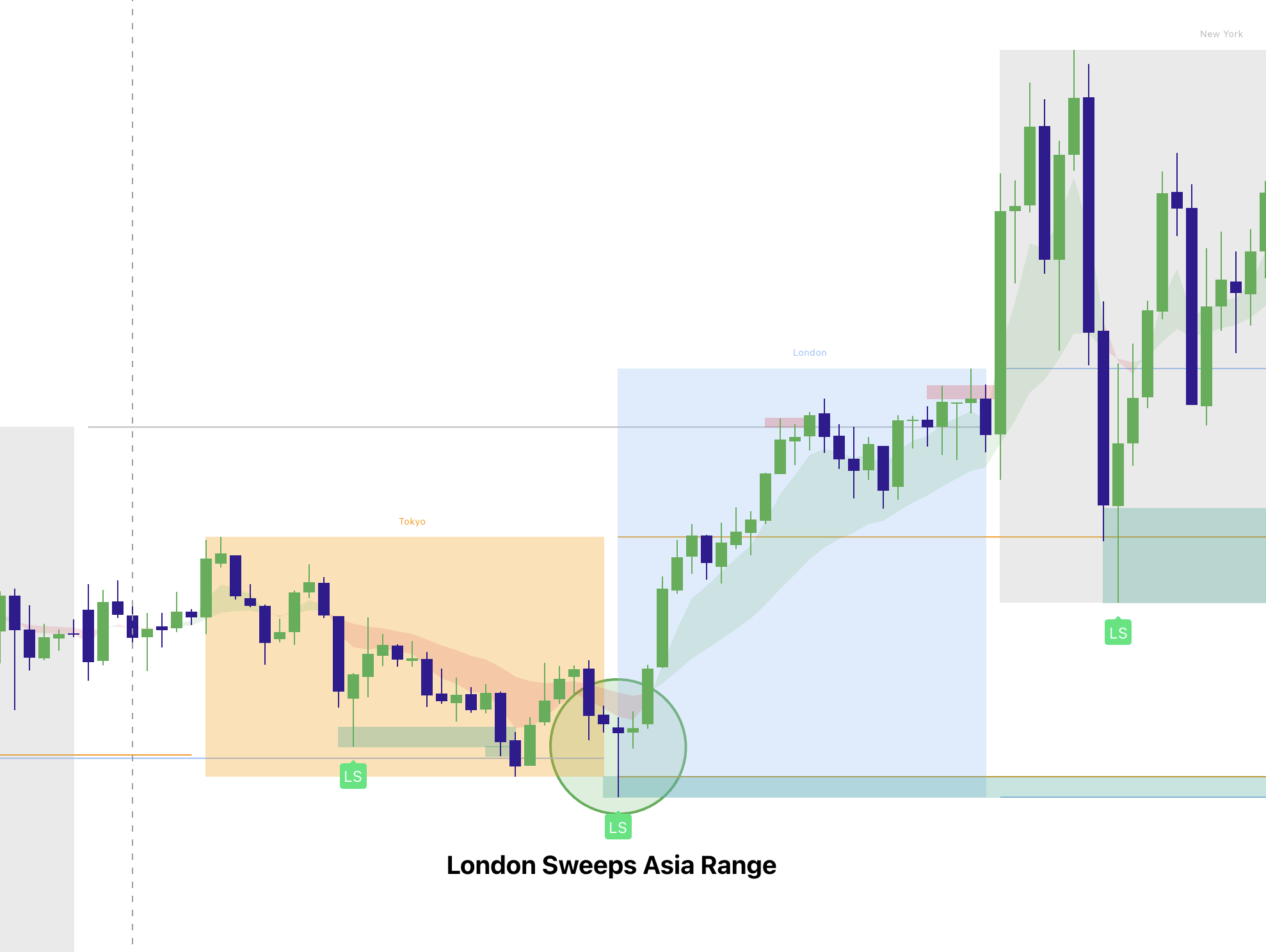
Each major session can create, test, or reprice liquidity differently. Viewing the day as a sequence helps contextualize Elev8 signals without assuming that every session must play a fixed role.
- Asia: Often builds an overnight range and visible session liquidity (The Setup).
- London: May test, sweep, or expand beyond Asian liquidity (The First Decision).
- New York: Can confirm continuation, reverse prior expansion, or establish a new cash-session range (The Repricing).
This is a practical framework. The value is in using session context to filter which liquidity events deserve attention, not in rigidly predicting which session must reverse or continue the prior move.
When Macro Levels Combine With Intraday Sweeps
The strongest Elev8 environments appear when independent layers align: Location (Macro Liquidity) + Rejection/Acceptance + Displacement + Confirmation.
- Price trades through or reacts at a strong higher timeframe boundary.
- The reaction shows reclaim, failed continuation, or opposite displacement.
- Elev8’s signal / zone tools confirm the trade thesis rather than creating it by themselves.
In these higher-confluence environments, price may begin a rotation away from the failed breakout, with VWAP, internal liquidity, RB/FVG structure, or the next external objective providing logical checkpoints.
Optional: Use Momentum Gaps, Reversal Blocks, and Real FVG to map the path after confirmation. They can help define retest zones, partial-profit checkpoints, invalidation, and continuation structure instead of relying only on “feel” once you’re in the trade.
Summary
- Liquidity often concentrates at predictable higher timeframe and session references.
- The strongest sweeps occur when your intraday reaction aligns with your macro liquidity map.
- Session sequencing adds context, but acceptance/rejection and displacement determine what the market is actually doing.
- Elev8 organizes location, extension, structure, confirmation, invalidation, and targets across multiple timeframes.
The big idea
When you understand how higher-timeframe liquidity interacts with intraday acceptance, rejection, and displacement, Elev8 becomes more than a signal tool. It becomes a full context framework for distinguishing meaningful reversal environments from genuine continuation.
Quick Checklist
- I can identify higher-timeframe liquidity magnets and macro context.
- I can understand how positioning and hedging can influence intraday behavior.
- I can use macro context without overriding real-time acceptance or rejection.
What Invalidates the Setup?
Stand aside when meaningful location, the expected price response, confirmation, clearly defined structural risk, or a realistic target is missing. A tool or signal by itself does not complete the trade thesis.
Common Mistakes
- Counting several correlated indicators as independent confluence.
- Trading a zone before price confirms the expected response.
Next Recommended Lesson
The Elev8+ Confluence Checklist: Stacking the Full Suite for High-Probability Setups →