
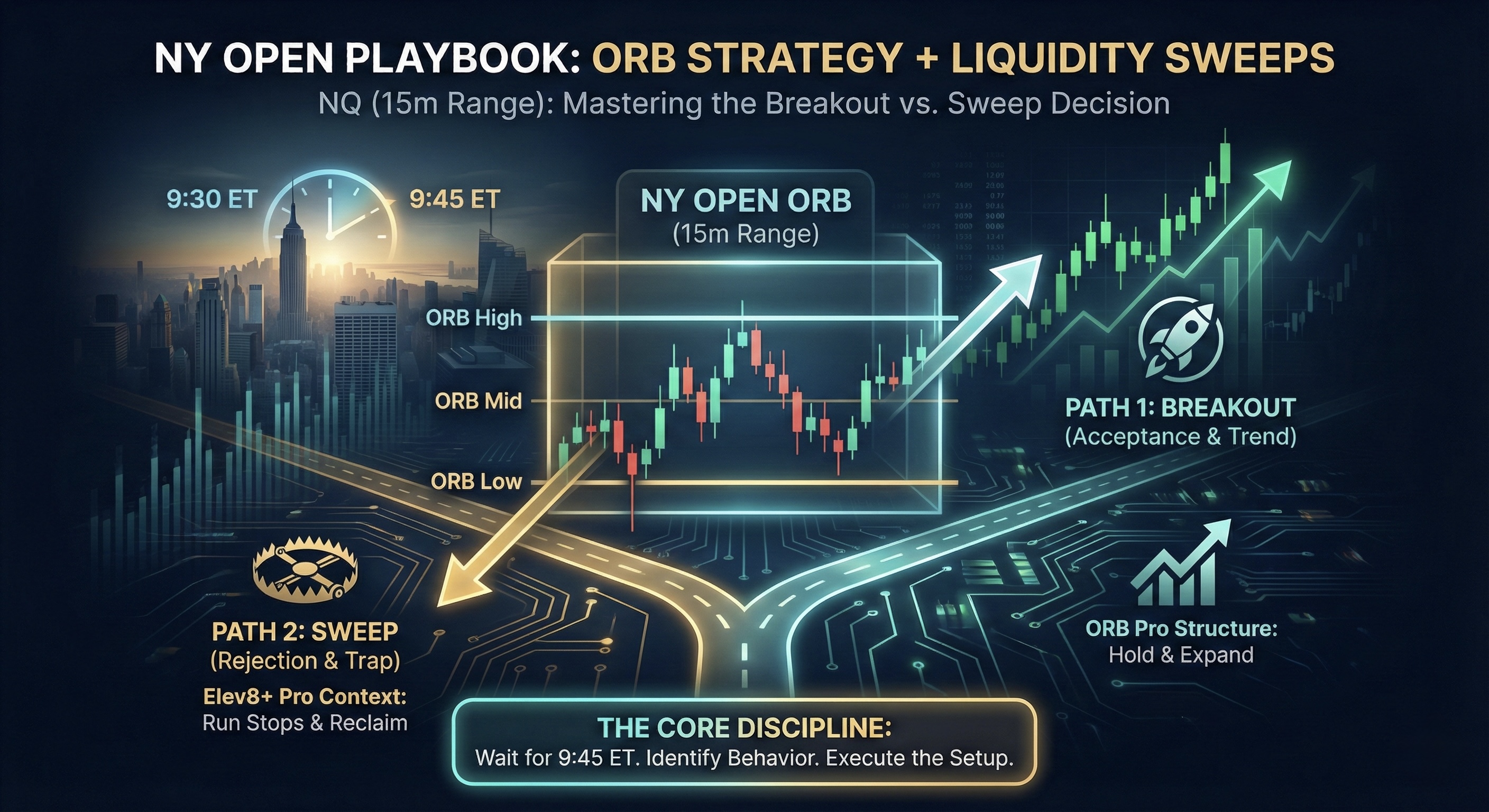
What You'll Learn
- Map the New York 15-minute opening range.
- Separate accepted breakout conditions from sweep-and-reclaim traps.
- Confirm structure and define invalidation before choosing direction.
NY Open Playbook • ORB Acceptance + Liquidity Sweeps
The NY Open ORB Strategy for NQ (15m Range): Acceptance, Sweeps, and How to Trade Both
The NY open is where many traders get chopped up because they react to the first break instead of waiting to see whether price accepts outside the opening range or fails back inside after taking liquidity. This guide breaks down how to separate true expansion from failed breakout behavior, then use ORB Pro and Elev8+ Pro to build entries around confirmation, retests, structural invalidation, and objective targets.
Educational content only. Not financial advice. No performance guarantees.
Core idea
After the ORB completes, focus on one question: does price accept outside the range or reject back inside after taking liquidity?
Tooling
ORB Pro defines the opening range and breakout structure. Elev8+ Pro helps evaluate sweeps, rejection, exhaustion, and reversal context at those levels.
Best habit
Treat 9:45 ET as an information checkpoint—not an automatic entry. Let the ORB complete, then trade only after acceptance or rejection begins to prove itself.
Why the NY Open ORB works
The first 15 minutes of the NY cash open (9:30–9:45 ET) creates a widely watched reference range while overnight positioning is repriced into cash-session participation. The value of the ORB is not that price must obey it—it is that the high, low, and midpoint become clear levels where breakout orders, stops, and later retests can concentrate. That creates a simple framework:
- The ORB becomes a shared reference level where later reactions can be measured objectively.
- Liquidity builds at obvious boundaries as stops and breakout orders cluster above the high and below the low.
- Price often chooses between two outcomes: acceptance beyond the boundary favors continuation; failure and reclaim favor rotation back into the range.
A simple way to think about the open
Use the ORB to judge whether price can establish value outside the completed range. A break that holds and survives a pullback supports continuation; a break that fails and reclaims the range is more consistent with a liquidity sweep.
Premarket ORB vs NY Open ORB: which range matters more?
For NQ, the NY cash open 15m ORB (9:30–9:45 ET) is the primary range in this playbook, because it creates a completed cash-session structure for measuring acceptance, rejection, and later retests.
The first 30 minutes of premarket (8:00–8:30 ET) is still useful as context: it can define secondary liquidity, early compression/expansion, and nearby levels that interact with the cash-session ORB.
Practical ranking (most days)
- NY Open 15m ORB (9:30–9:45 ET) — primary structure for acceptance, rejection, and retests.
- Overnight range (ON high/low) — major external-liquidity reference that can strengthen the ORB story.
- Premarket 30m (8:00–8:30 ET) — secondary structure useful for confluence and liquidity objectives.
The two NY open behaviors you must separate
Most traders get trapped because they force a reversal playbook into acceptance—or chase a breakout that is already failing. After the ORB completes, classify the behavior before choosing the trade:
1) ORB Breakout Day (break → acceptance → continuation)
This is when price breaks the ORB high/low and holds outside. The defining feature is acceptance: closes remain beyond the boundary, pullbacks stay corrective, and the broken ORB level begins acting as support or resistance.
2) ORB Trap Day (sweep → failure → reclaim)
This is when price trades through the ORB boundary, takes liquidity, and then reclaims back inside. The strongest trap setups add failed continuation, rejection, opposite displacement, or a micro structure shift instead of relying on the sweep wick alone.
NY Open Decision Tree (simple)
Step 1: Let the ORB complete at 9:45 ET.
Step 2: If price breaks ORB and accepts outside with a defended boundary → prioritize ORB breakout continuation.
Step 3: If price breaks ORB and then reclaims inside after failure/rejection → evaluate ORB trap / reversal.
This is a framework for analysis and education. Always define risk and trade only what fits your plan.
Should you trade immediately at 9:45 or wait?
Use 9:45 ET as the “information checkpoint,” not a required entry time. Trading before the ORB completes means the final high and low are still developing, so the structure you are trading is less defined.
A practical approach that reduces fakeouts
- At 9:45: mark ORB high/low/mid and identify nearby ONH/ONL, PDH/PDL, and premarket liquidity.
- Wait for either: acceptance outside the range or failure/reclaim back inside.
- Then execute the continuation or reversal play that matches what price has actually proven.
Strategy A: ORB breakout continuation (trend day play)
Your edge on a breakout day is not “it broke, so I buy/sell.” The cleaner sequence is: break + acceptance + structure, ideally followed by a controlled retest before continuation.
Entry concepts (pick one and stay consistent)
- Retest entry: price breaks ORB, pulls back to the boundary, then holds. A fresh FVG/RB overlapping the retest strengthens the structure.
- Hold entry: price breaks ORB and builds acceptance outside before resuming from consolidation.
- Momentum entry: immediate break with strong displacement and little pullback; this carries the highest fakeout risk.
Targets
- ORB range projections: 1x and 2x of the ORB range provide objective expansion references.
- Liquidity targets: ON high/low, premarket highs/lows, PDH/PDL, or the next mapped external-liquidity level.
Strategy B: ORB sweep-and-reclaim (trap day play)
Trap setups begin when price removes liquidity outside the ORB but cannot convert the breakout into acceptance. The “tell” is it cannot hold outside the ORB, then begins showing reclaim and opposite response.
What you want to see
- Sweep: price trades through ORB high/low or another nearby external-liquidity level.
- Reclaim: price returns inside the ORB and fails to rebuild acceptance beyond the swept boundary.
- Follow-through: opposite displacement or a micro structure break confirms that the sweep is becoming a reversal rather than a pause.
Targets
- First target: ORB midline or the nearest internal liquidity / micro swing.
- Second target: opposite ORB boundary if rejection and displacement remain clean.
- Context targets: VWAP, internal range structure, or the next mapped liquidity objective.
Stop loss types (choose what fits your style)
There are multiple valid stop styles, but the stop should sit beyond the price action whose failure would invalidate the trade thesis—not at an arbitrary distance.
Wick-based stop
Place the stop beyond the sweep/rejection extreme for a trap play or beyond the defended retest low/high for a breakout play. Tight risk only makes sense when that wick or retest actually defines the thesis.
Structure stop
Stop beyond a confirmed swing, reclaimed level, RB/FVG, or other structure that must hold for the setup to remain valid. More durable, but often wider.
Volatility stop
Use ATR/volatility sizing to keep normal noise from defining the stop. Volatility can calibrate distance, but the final stop should still make structural sense.
How ORB Pro and Elev8+ Pro fit into the strategy
The strategy comes from reading price behavior at meaningful structure. The indicators organize that information and help make the process more consistent.
ORB Pro: structure, levels, and objective breakouts
- Draws the ORB (NY 15m by default) so the completed range is defined consistently every day.
- Extends levels forward so you can trade the reaction and retest later, not just during the window.
- Breakout method: use Close to emphasize acceptance and Wick only if you intentionally want earlier, noisier information.
- Targets: optional 1x and 2x projections help standardize expansion objectives and reduce emotional exits.
Elev8+ Pro: sweep context, exhaustion, and reversal structure
- Highlights liquidity sweeps so failed ORB breaks can be evaluated inside a broader liquidity story.
- Shows structured reversal context that can help distinguish a developing reversal from a breakout that still has directional strength.
- Pairs well with ORB because many sweeps occur at ORB boundaries, ON highs/lows, and other obvious session levels.
Combined playbook (how to actually use both)
If price breaks ORB and holds outside: treat the ORB as continuation structure. Prefer a corrective retest, successful level flip, or fresh FVG/RB before chasing an extended breakout.
If price breaks ORB and reclaims inside after a sweep: treat the failed breakout as reversal context. Look for rejection, opposite displacement, and clear invalidation before targeting the midline or opposite boundary.
Common NY open mistakes (and the fixes)
-
Mistake: treating every ORB break as a trend day.
Fix: require acceptance, a successful level flip, or a structured retest before committing to continuation. -
Mistake: fading every push outside the ORB instantly.
Fix: wait for failure, reclaim, and preferably opposite displacement or a micro structure shift before taking the trap play. -
Mistake: no standardized targets or exits.
Fix: map targets before entry using internal liquidity, ORB midline/opposite boundary, 1x/2x projections, and nearby external liquidity.
What to journal (to improve the strategy fast)
If you want to evaluate whether the ORB framework is actually improving your decisions, journal the market behavior and execution process—not just P&L:
- Did price accept outside the ORB or fail/reclaim back inside?
- Was the break supported by displacement and a successful retest, or did it behave like a liquidity sweep?
- Where was the ORB relative to ONH/ONL, PDH/PDL, premarket structure, and other major liquidity?
- Did your stop sit beyond true structural invalidation, and did your targets match the continuation or reversal playbook?
Want to see this on real charts?
Watch the Elev8+ demo to see how ORB structure, liquidity sweeps, rejection, and continuation context work together in real time, and use ORB Pro to define the NY open range consistently before deciding whether price is accepting or failing beyond it.
Indicators and examples are provided for educational purposes only and are not trade recommendations. You are responsible for all decisions and risk management.
Quick Checklist
- I can map the New York 15-minute opening range.
- I can separate accepted breakout conditions from sweep-and-reclaim traps.
- I can confirm structure and define invalidation before choosing direction.
What Invalidates the Setup?
Stand aside when meaningful location, the expected price response, confirmation, clearly defined structural risk, or a realistic target is missing. A tool or signal by itself does not complete the trade thesis.
Common Mistakes
- Counting several correlated indicators as independent confluence.
- Trading a zone before price confirms the expected response.
Next Recommended Lesson
How to Trade London & NY Session Liquidity Sweeps with Elev8+ (Asian Range + London High/Low) →