
What You'll Learn
- Identify when London and New York liquidity participation is strongest.
- Use session timing as context rather than a standalone entry signal.
- Avoid low-participation periods and forced setups.
Best Intraday Time Windows for Elev8+ Liquidity Sweeps
Not all sweeps carry the same context. Elev8+ signals are generally easier to evaluate when the market is actively repricing, liquidity is interacting with major session boundaries, and price is showing clear rejection or acceptance. Understanding the most active intraday windows helps you filter setups—but the clock should never replace location, structure, and confirmation.
Time Zone Note
All times listed below are in New York time. This means Eastern Standard Time in winter and Eastern Daylight Time in summer. Make sure your TradingView chart time matches America/New_York so these windows adjust correctly through daylight-saving changes.
Your execution trigger can still come from Elev8+ Pro (levels + triangle/LS confirmation), but timing becomes more useful when each tool answers a separate question: Market Map confirms session/HTF liquidity and value, Market Extremes / VWAP Deviation show whether price is genuinely stretched, and Momentum Gaps / Reversal Blocks / Real FVG help distinguish failed expansion and defendable retests from clean continuation.
Why Timing Matters
Liquidity events become more actionable when one of two conditions is present:
- Participation increases around a session transition, cash open, close, or scheduled catalyst.
- Stops and breakout orders are concentrated around obvious external-liquidity levels.
The Golden Rule: Participation helps, but volume alone does not validate a sweep. A high-volume break can still be genuine continuation, while a lower-volume reversal can still work if location and structure are strong.
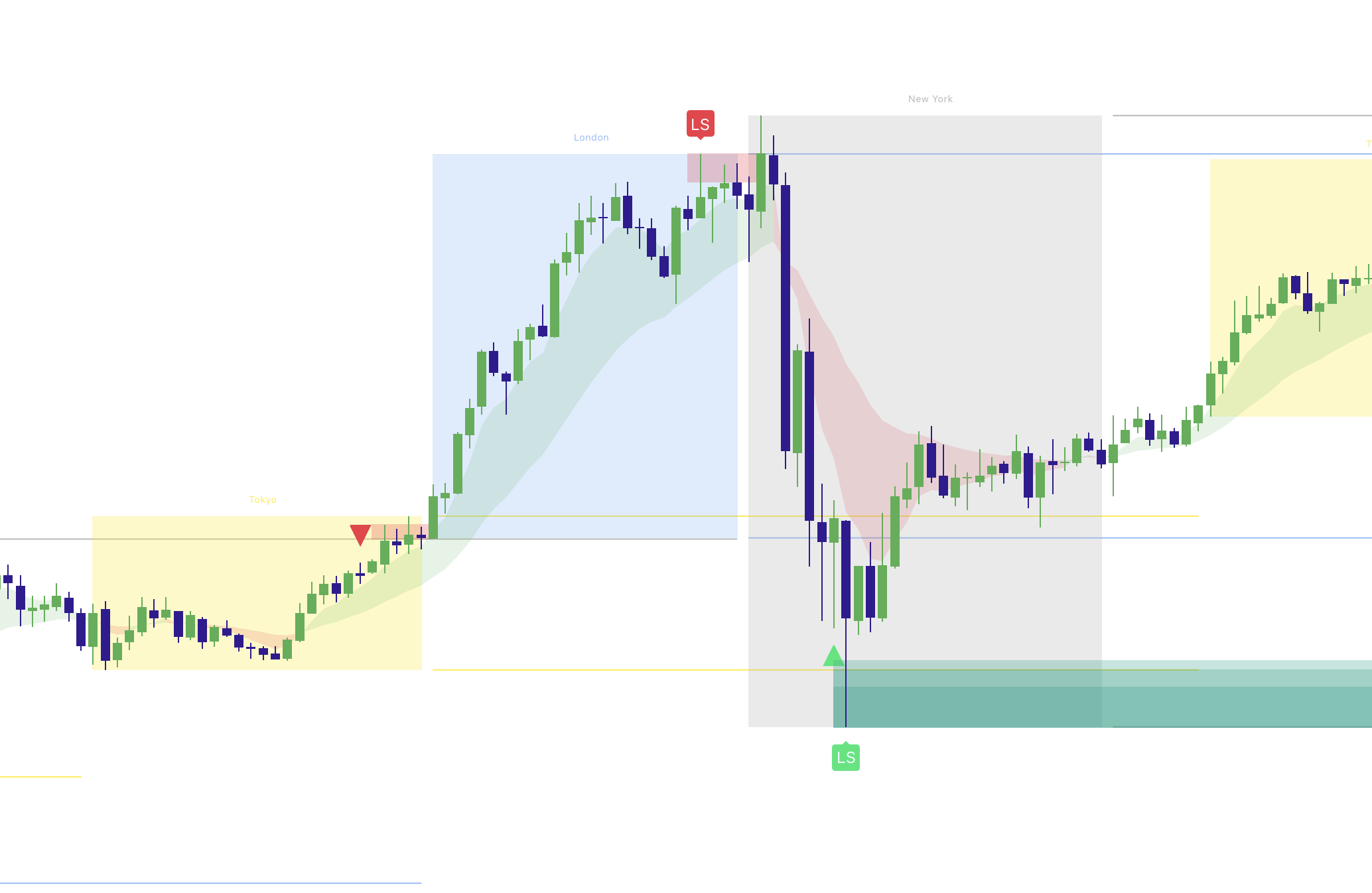
Zone 1: The London Sweep (3:00 AM – 4:00 AM New York time)
London begins trading after the Asian session has already created visible highs, lows, and overnight structure. This transition can produce either a failed liquidity run or genuine expansion beyond the Asian range.
- Target: Watch how price interacts with Asia highs/lows and other nearby external liquidity.
- Behavior: Fast expansion, sharp rejection, or clean acceptance can all occur.
- Why trade it? The session transition often creates clearer liquidity decisions before New York becomes active.
Optional confluence: Use Market Map to mark Asia range boundaries + nearby HTF liquidity, use Market Extremes / VWAP Deviation to judge extension, and use Momentum Gaps / RB / Real FVG to determine whether the move is rejecting and rotating or accepting and continuing.
Zone 2: The NY Open "Judas Swing" (9:30 AM – 10:30 AM New York time)
The New York cash open is one of the most active repricing windows of the day. Failed breakouts are common, but so are genuine trend expansions—so do not assume the first move must be a trap.
- Target: Prior Day High/Low (PDH/PDL), Overnight High/Low, premarket structure, and the completed ORB.
- Behavior: High volatility with both sweep-and-reclaim and breakout-acceptance opportunities.
- Strategy: Let the initial liquidity event resolve, then trade the behavior: reclaim/rejection for reversal or defended acceptance for continuation.
- Market Map: Is price interacting with real external liquidity (PDH/PDL, ONH/ONL, session extreme, ORB) or random space?
- Market Extremes / VWAP Deviation: Is price genuinely extended, or is the move simply strong directional acceptance?
- Momentum Gaps / RB / Real FVG: Does the reaction create opposite displacement and defendable structure—or fresh same-direction structure supporting continuation?
The "No Fly Zone": NY Lunch (12:00 PM – 1:30 PM New York time)
Be more selective during this window. Participation can slow and ranges can compress, which often reduces displacement and makes follow-through less reliable. The problem is not that lunch trades cannot work—it is that mediocre setups can become harder to distinguish from ordinary chop.
- Risk: Reduced follow-through, repeated level tests, and two-sided range behavior.
- Advice: If your own journal shows weaker performance here, protect the morning and wait for a cleaner session window.
Exception: A major HTF/session liquidity event with clean reclaim, displacement, and defined invalidation can still be valid. Treat lunch as a selectivity filter, not a universal ban.
Zone 3: The Afternoon "Power Hour" (2:30 PM – 4:00 PM New York time)
As markets move toward the cash close, participation and volatility can increase again. Late-session moves may extend the day’s trend, run remaining liquidity, or rotate out of a midday balance.
- Target: Intraday highs/lows, midday range extremes, PDH/PDL, and other nearby external-liquidity objectives.
- Behavior: Watch for both late-day continuation and failed liquidity runs rather than assuming every stop run must mean-revert.
Optional confluence: If Market Map shows price extended into major liquidity and Market Extremes / VWAP Deviation + Momentum Gaps / RB / Real FVG confirm stretch and failed continuation, the late-day reversal thesis becomes stronger.
Crucial Warning: "Red Folder" News Events
Major economic releases such as CPI, PPI, employment data, and FOMC-related events can create abrupt volatility, often around 8:30 AM or 2:00 PM New York time.
Do not assume a sweep during a major release is immediately fadeable. Price can trade through multiple levels before structure stabilizes. Unless news trading is part of your tested plan, use a predefined post-release stabilization rule, then require reclaim / rejection or acceptance before deciding whether the next trade is reversal or continuation.
How Elev8+ Helps You Track Timing With Less Work
Elev8+ Pro and Market Map reduce prep by organizing the session and HTF references you actually care about, including:
- Asia H/L
- London H/L
- NY H/L / ORB structure
- PDH/PDL + Overnight H/L
- VWAP / deviation context and nearby structural zones
This makes it easier to focus on important boundaries without manually labeling every possible level. The goal is a clean chart and a short list of liquidity events you are willing to trade when timing, location, and structure align.
Summary
Key takeaways
- London (3–4 AM New York time): Useful for studying Asia-range sweeps, acceptance, and early-session expansion.
- NY Open (9:30–10:30 AM): High-activity window for both failed breakouts and genuine continuation.
- Lunch (12–1:30 PM): Often slower—raise your selectivity rather than assuming every setup is invalid.
- Power Hour (2:30–4 PM): Watch for both end-of-day liquidity runs and continuation toward closing-session objectives.
- News Events: Verify the calendar and let structure form before treating post-release volatility as a reversal.
If you focus Elev8+ execution around active session transitions while still requiring meaningful liquidity, acceptance/rejection, and structural confirmation, your trade selection becomes cleaner without turning time of day into a standalone signal. Timing is context — the setup still has to prove itself.
Quick Checklist
- I can identify when London and New York liquidity participation is strongest.
- I can use session timing as context rather than a standalone entry signal.
- I can avoid low-participation periods and forced setups.
What Invalidates the Setup?
Stand aside when meaningful location, the expected price response, confirmation, clearly defined structural risk, or a realistic target is missing. A tool or signal by itself does not complete the trade thesis.
Common Mistakes
- Choosing size before defining structural invalidation.
- Improvising entries, exits, or rules after the trade begins.