
What You'll Learn
- Identify a qualified sweep with a failed breakout.
- Confirm rejection before targeting a rotation toward VWAP or value.
- Define wick-based invalidation and asymmetric reward before entry.
The Elev8 Sweep + VWAP Strategy Breakdown
The Sweep + VWAP reversion is one of the clearest mean-reversion frameworks inside the Elev8 system. The setup is built around a simple sequence: price reaches meaningful external liquidity, fails to sustain the breakout, and begins rotating back toward value.
The "Rubber Band" Analogy
Think of VWAP as a reference for intraday value and price as a rubber band. When price becomes extended, sweeps meaningful liquidity, and then fails to continue, the probability of rotation toward value can improve—but VWAP is a target candidate, not a force that price must obey.
Why Sweeps and VWAP Pair So Well
A failed breakout at meaningful liquidity can create a rotation back toward areas where more two-sided trade previously occurred. VWAP is useful because it provides one objective reference for that intraday value.
VWAP is widely used as an execution benchmark and reference for average traded price during the session. Because many traders and execution systems monitor it, VWAP can become an important reaction area. It should be treated as context and a potential objective, not as a universally agreed “fair price” or guaranteed magnet.
This creates a clean and teachable sequence:
- Sweep removes meaningful external liquidity at a known reference.
- Rejection is confirmed by reclaim, failed continuation, and preferably opposite displacement.
- Rotation targets nearby internal liquidity, VWAP, or another mapped value reference.
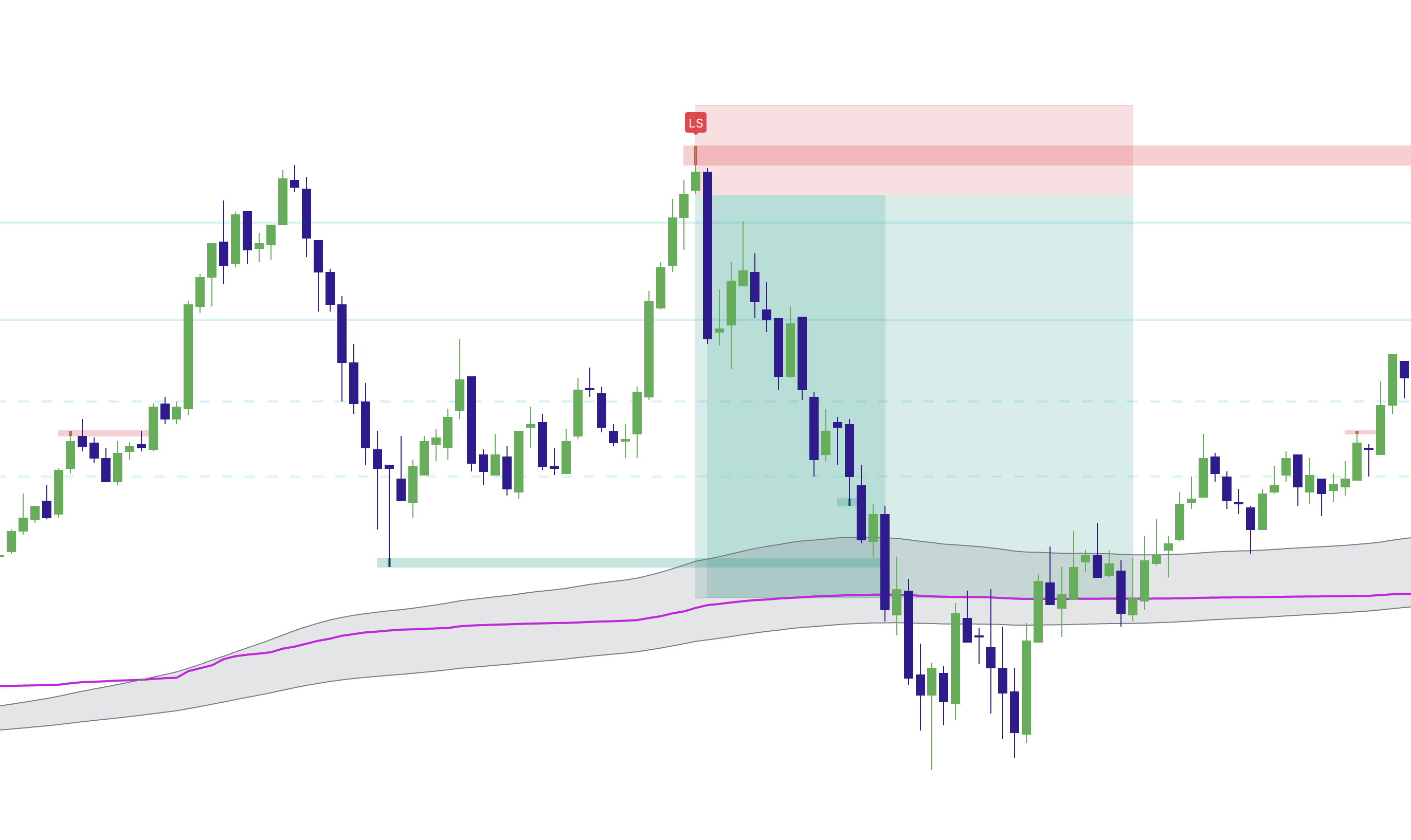
Step 1: Identify a Qualified Sweep (The Stretch)
A qualified sweep is not simply any wick beyond a local high or low. Higher-quality reversal candidates usually form when:
- Price runs a major external-liquidity level such as PDH/PDL, session extremes, or another important HTF reference.
- Price is meaningfully extended relative to value or recent structure.
- The breakout fails to continue beyond the level.
- Price reclaims / displaces back inside and begins confirming a structure shift.
Elev8 confirms this behavior using:
- Triangle reversal signals as higher-frequency attention triggers around the liquidity event.
- LS labels as more selective confirmation, with RB/FVG structure available for refined retest entries.
Step 2: Define Structural Invalidation (The Safety)
Sweep reversals can offer a clean risk model when you identify the structure that must hold for the failed-breakout thesis to remain valid.
- Shorts: Risk belongs above the structure that would prove the upside breakout is succeeding again.
- Longs: Risk belongs below the structure that would prove the downside breakout is succeeding again.
Rule of Thumb: The sweep wick is often relevant, but the stop should be tied to structural invalidation—not an automatic fixed distance beyond every wick.
Step 3: Target Value First (The Rotation)
After a qualified sweep, map the nearest realistic value or internal-liquidity objective:
- Target 1: VWAP, internal liquidity, or the nearest meaningful value reference
- Target 2: Mid-range, opposing structure, or another mapped liquidity objective
Crucial Filter: Is VWAP Flat or Angled?
VWAP slope can provide useful regime context, but it should be combined with structure rather than used as a standalone market-state detector.
When VWAP is relatively flat and price is rotating repeatedly around value, the environment may be more favorable for mean-reversion setups. Boundary sweeps can have cleaner paths back toward internal liquidity or VWAP.
When VWAP is persistently angled and price is accepting away from it with strong displacement, the market may be in a directional regime. Raise the confirmation standard for countertrend fades unless meaningful external liquidity, extension, and structure all support reversal.
Step 4: Extended Targets
If price reaches VWAP and the reversal continues defending structure, you can consider extended objectives:
- The opposite side of the active range or the next meaningful internal/external-liquidity objective.
- The next major Market Map / RB / FVG reference in the path of the move.
Step 5: Best Timing Windows
Sweep + VWAP reversions are often easier to evaluate during active session transitions such as:
- London interactions with Asia liquidity, especially when extension and rejection are clear
- New York Open (9:30 - 10:30 AM New York time): Watch PDH/PDL, ONH/ONL, premarket structure, and ORB behavior for either failed breakout or acceptance.
- Late-session liquidity runs near important daily extremes, especially after a midday balance.
When to Skip the Setup
Stand aside when the structure does not support a qualified mean-reversion thesis:
- No meaningful external-liquidity or HTF reference is present at the extreme.
- Price keeps accepting beyond the level with same-direction displacement and defendable continuation structure.
- VWAP / value is being defended: If price repeatedly rejects away from VWAP while trend structure remains intact, do not assume a sweep must rotate through it.
Summary
Quick checklist
- Wait for price to sweep a meaningful external-liquidity level.
- Use VWAP slope and VWAP Deviation / Market Extremes to judge value and extension context.
- Confirm failed continuation with an Elev8 triangle / LS plus reclaim or displacement.
- Place your stop beyond structural invalidation.
- Target VWAP or the nearest realistic value / liquidity objective first.
This is a foundational Elev8 framework because it replaces prediction with a sequence of observable conditions. You are not assuming every extreme must reverse. You are waiting for meaningful liquidity to be taken, requiring the breakout to fail, and then using VWAP and surrounding structure as objective references for the rotation.
Quick Checklist
- I can identify a qualified sweep with a failed breakout.
- I can confirm rejection before targeting a rotation toward VWAP or value.
- I can define wick-based invalidation and asymmetric reward before entry.
What Invalidates the Setup?
Stand aside when meaningful location, the expected price response, confirmation, clearly defined structural risk, or a realistic target is missing. A tool or signal by itself does not complete the trade thesis.
Common Mistakes
- Counting several correlated indicators as independent confluence.
- Trading a zone before price confirms the expected response.