What You'll Learn
- Reject sweeps that occur at weak or random locations.
- Recognize acceptance, poor displacement, and incomplete rejection.
- Stand aside when confirmation, invalidation, or reward is unclear.
Sweep Invalidation Rules: When an Elev8 Sweep Is NOT a Trade
Elev8 sweep reversals can be useful, but they should never be traded blindly. A reversal-quality sweep needs meaningful location, failed continuation / structural rejection, and enough participation or displacement to show that the breakout is actually losing control. This guide is designed to help you invalidate weak sweeps before they become low-quality trades.
Your execution trigger can still come from Elev8+ Pro (levels + triangles/LS), but invalidation becomes clearer when each tool answers a separate question: Market Map confirms meaningful HTF/session liquidity, Market Extremes / VWAP Deviation show whether price is actually stretched, and Momentum Gaps / Reversal Blocks / Real FVG show whether displacement and retest structure support reversal or continuation. These tools are optional—use them to add independent evidence, not to overcomplicate.
The Traffic Light Check
Before every trade, ask:
RED LIGHT: Is price showing strong acceptance, continued displacement, or a successful level flip? (Stop)
YELLOW LIGHT: Is the rejection weak, location mediocre, or structure incomplete? (Caution / Wait)
GREEN LIGHT: Is it at meaningful liquidity with reclaim, opposite response, and clear invalidation? (Evaluate)
Reminder: Triangles are higher-frequency attention triggers and can appear in lower-quality conditions. LS is more selective—but still requires meaningful location, rejection/structure, and a valid risk model.
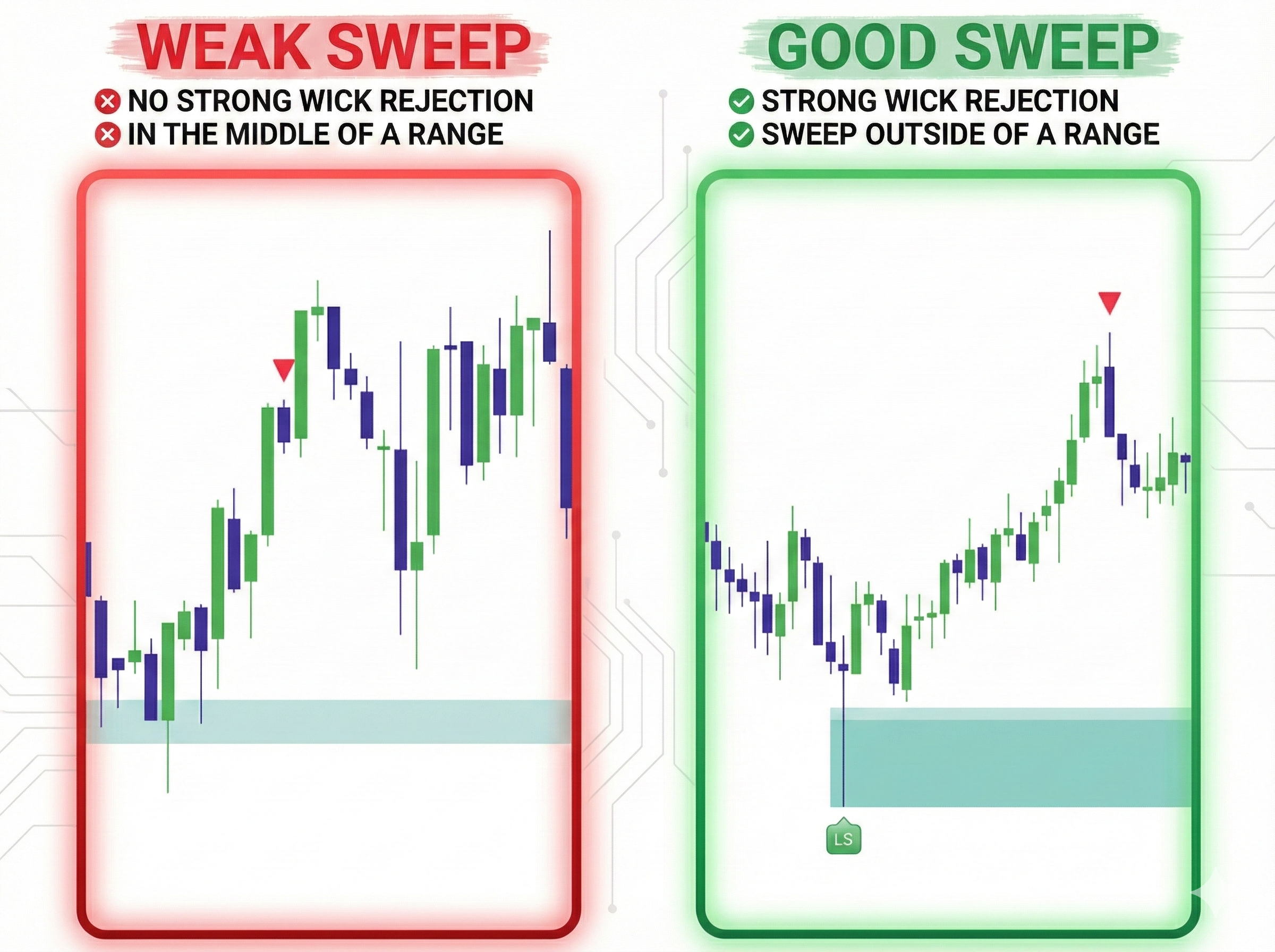
Invalidation Rule 1: The “Middle of Nowhere” Sweep (No Level)
A sweep is far less meaningful if price is not interacting with visible external liquidity or important structure. If a triangle appears in the middle of a range with no level narrative, deprioritize or skip it.
- Prior Day High / Low (Primary daily external liquidity)
- Session highs & lows (Overnight, Asia, London, New York)
- Weekly / Monthly extremes or major HTF swings
Optional confluence: If Market Map is not showing nearby external liquidity and price is not interacting with a meaningful value or HTF reference, you may be looking at local noise rather than a structurally important liquidity event.
Invalidation Rule 2: The “Strong Trend” Sweep (Continuation Risk)
Strong trend acceptance is one of the biggest risks when fading reversals. A countertrend sweep needs more evidence than a wick against persistent directional flow.
Trend Day Warning
If the market has been trending strongly with shallow pullbacks, repeated displacement, and sustained trade away from value, do not fade the first sweep you see. Strong trends can trade through multiple liquidity levels before a reversal develops. Wait for failed continuation, reclaim, opposite displacement, or a meaningful structure shift before entering.
Optional confluence: Market Extremes / VWAP Deviation can show extension, but extension alone does not invalidate a trend. If price keeps expanding and defending new structure, treat early reversal signals as continuation risk until price proves otherwise.
- Skip the fade when price closes repeatedly beyond the level, continues displacing, and then defends the breakout on pullback.
- If the reclaim never develops and the old level starts acting as new support/resistance, treat that as acceptance until proven otherwise.
Invalidation Rule 3: Weak or Sloppy Rejection Structure
A sweep candle can help tell the story, but the candle shape itself is not the entire setup. What matters is whether price actually fails to continue beyond the level.
- Stronger Rejection: Clear excursion beyond the level followed by reclaim, close away from the extreme, or immediate opposite response.
- Weaker Rejection: Small wick, large acceptance body, repeated closes near the extreme, or no meaningful displacement away.
Rule of thumb: if the market is still comfortably accepting around the breakout area, do not label it a reversal simply because one wick exists.
Invalidation Rule 4: Low Participation or Poor Follow-Through
Sweeps during slower periods can still work, but reduced participation often produces weaker displacement and more two-sided chop. The issue is not the clock by itself—it is whether the setup produces enough follow-through to justify the reversal thesis.
If price cannot separate from the sweep and structure stays stagnant, stand aside or reduce risk.
Invalidation Rule 5: Sweep Without Complete Rejection (Acceptance vs. Rejection)
A reversal-quality sweep is incomplete until price shows that the breakout is failing. The close matters, but reclaim plus subsequent structure matters more than a wick by itself.
- Did price reclaim back inside the level zone?
- Did price show failed continuation / opposite displacement instead of immediately accepting back outside?
- Is the triangle/LS printing at the liquidity event, not after price is already extended away?
- Not a Trade: Price trades through the level but continues closing and building structure outside with no failed continuation.
- Requirement: Look for reclaim plus evidence that the old breakout direction is losing control. If price holds and successfully retests the level, that is acceptance, not rejection.
Optional confluence: Momentum Gaps / Real FVG can help here. Continued same-direction displacement with fresh valid imbalance and no reclaim supports continuation; a reversal that creates opposite displacement and a defendable RB/FVG supports the fade thesis.
Invalidation Rule 6: Sweeps Inside Micro Consolidation
Some “sweeps” occur within narrow boxes or small local ranges. These can be useful for scalping, but they should not be confused with meaningful external-liquidity reversals.
- Deprioritize sweeps that only run a tiny local high/low inside a tight box unless your strategy is specifically built for micro liquidity.
- Prefer reversals that reach external liquidity (session extremes, PDH/PDL, weekly/monthly, major HTF swings) and then prove failure.
Optional confluence: If Market Extremes shows ordinary mid-range conditions and Market Map shows no nearby major liquidity, micro sweeps should generally carry less weight than external-liquidity events.
When to Size Down or Skip Entirely
If one or more major warning conditions are present:
- Reduce size only if the remaining setup still meets your minimum rules, or
- Skip the trade entirely when the thesis is incomplete or acceptance is contradicting the fade.
Higher-quality reversal entries tend to occur when these conditions align:
- Meaningful external liquidity is present.
- Price fails to continue beyond the level.
- Reclaim / displacement / structure confirms the rejection.
- The setup is not fighting clean acceptance or persistent trend continuation.
Summary
- No meaningful liquidity = Deprioritize / Skip.
- Strong acceptance / trend continuation = Skip the fade until structure changes.
- Repeated closes + defended retest outside = Continuation risk.
- No reclaim / no opposite response = Reversal thesis incomplete.
- Low participation + no displacement = Reduce expectations or Skip.
Final mindset
Trading Elev8 is not about taking more signals. It is about rejecting weak setups until you are consistently focusing on the liquidity events that occur in the right place, with the right failure, structure, and confirmation.
Quick Checklist
- I can reject sweeps that occur at weak or random locations.
- I can recognize acceptance, poor displacement, and incomplete rejection.
- I can stand aside when confirmation, invalidation, or reward is unclear.
What Invalidates the Setup?
Stand aside when meaningful location, the expected price response, confirmation, clearly defined structural risk, or a realistic target is missing. A tool or signal by itself does not complete the trade thesis.
Common Mistakes
- Choosing size before defining structural invalidation.
- Improvising entries, exits, or rules after the trade begins.