The Problem This Guide Helps You Solve
Real FVG highlights gaps that follow a strong move and a confirmed break of a previous swing high or low. The aim is to distinguish a structure-related continuation area from an arbitrary gap. A qualifying gap still needs context and does not promise that price will return or continue afterward.
How to use this in your workflow
Work through these checks in order. The examples explain a process; they are not instructions to place a trade.
Identify the move and structure break
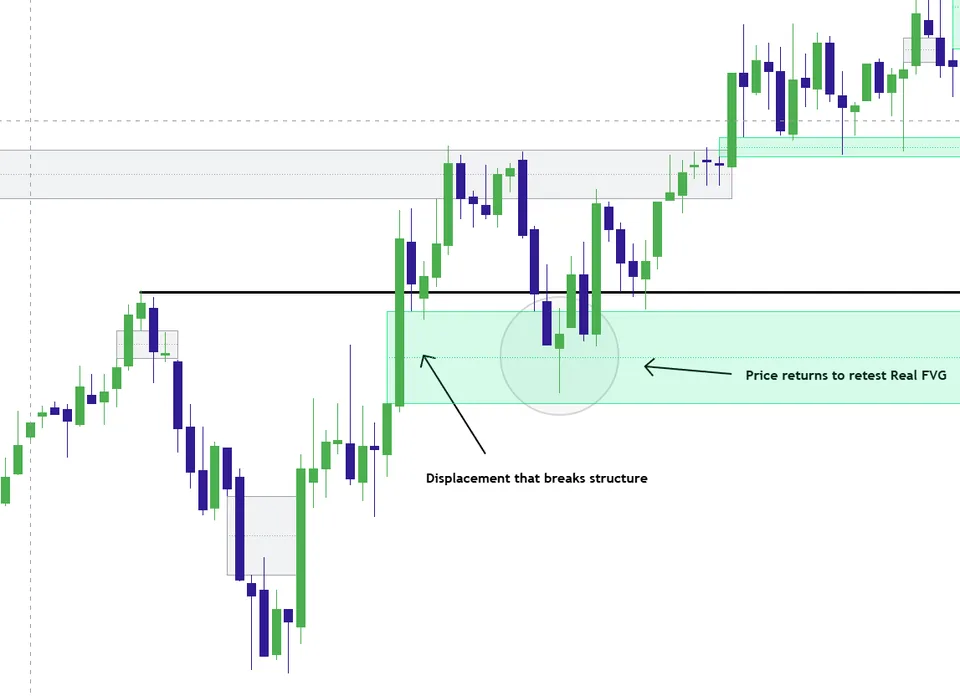
Inspect the prior swing reference and the move that broke it. The gap is only one part of the explanation. If you cannot explain the structure change, avoid treating the shaded area as a self-contained trading system.
Plan a possible pullback
Use the gap and its midpoint to define an area to observe if price returns. Waiting for a retest and entering immediately after a strong move are different plans. Decide which one your rules describe before reviewing the outcome.
Check whether the continuation idea survives
Watch how price behaves on the revisit. A reaction that supports continuation differs from acceptance through the gap and back into prior structure. Keep the invalidation condition explicit so a failed continuation idea does not quietly turn into an unrelated trade.
Examples and limits
A hypothetical chart-reading example
A strong upward move breaks a prior swing high and leaves a qualifying gap. Price later pulls back into that area. Study whether the retest supports the original continuation idea; do not assume the midpoint must hold simply because the gap met the indicator's filters.
What this tool cannot tell you
A gap may never be revisited, and a qualifying structure break can fail. Historical highlights are not evidence of guaranteed fills or a particular win rate.
Common Execution Mistakes To Avoid
-
Treating a historical example as a promised future outcome.
-
Adding a tool without understanding which decision it supports.
See where Real FVG fits into the Elev8+ workflow, then compare the current indicator plans on the suite page. Start with the free lessons if you want more explanation before deciding.
Related Guides
-
The Elev8+ Indicator Suite: What Each Tool Does
Compare the roles of Elev8+ Pro, Market Map, Market Extremes, VWAP Deviation, Reversal Blocks, Real FVG, and Momentum Gaps before building your chart.
-
TradingView Fair Value Gaps: Identify and Review Zones
A fair value gap describes a three-candle price imbalance. Learn how to review its location and later price reaction without assuming the gap must fill.
-
Momentum Gaps: Imbalances, Impulse Zones and Context
Explore how Elev8+ Momentum Gaps maps imbalances, impulse zones, and order-block context, and how its broader view differs from Real FVG.
Further Reading
About this guide
Published by Elev8+ Trading to explain trading concepts and our products. Elev8 sells the tools linked here; these guides are not independent product rankings or personalized financial advice. Chart examples illustrate a process, not audited trading results.
Dates identify substantive content updates, not a claim of independent expert review. Check current exchange, broker, and prop-firm rules before relying on a calculation. Ask a question or report a correction.